Saturday, December 12, 2015

RE-RELEASE THOUGHTS - 'The Iron Giant'

It's the '90s animated feature that got away, but oh my, revenge is sweet! Yes sir, animation auteur Brad Bird has remastered The Iron Giant and directed two new scenes. Let me repeat: the re-release of The Iron Giant contains two newly-animated sequences that qualify as the first bits of mainstream American feature 2D animation since 2011's Winnie The Pooh. But we'll get to that.

Giant is the gem in Warner Brothers' brief slew of animated features including Quest For Camelot and Osmosis Jones (yuck and yuck). You know the story: boy befriends robot. Military wants robot destroyed. Boy saves robot. Well, vice-versa, actually. It's E.T. meets 1950s b-movies, plus sharp storytelling and stellar craftsmanship.

All of Brad Bird's trademarks are present: the pacing is energetic, the cinematography whizzes all around, and the character designs are exquisite caricatures [that often resemble Bird himself]. Oh, and retro '50s-'60s landscapes and gadgetry! Gotta have those, unless you're Ratatouille.

Brad Bird nostalgically introduces his new edition with rough animation, pencil tests, and a plea for audiences to put down their devices and see movies on the big screen. Looking around, I noticed many small kids in the audience who very likely had not seen the film before, and it was comforting to know their parents took them to an animated feature with class and assured direction.

Having only seen the panned-and-scanned VHS version, seeing it remastered in it's original 2.35:1 ratio was like seeing it for the first time again. I picked up on a marvelous detail this time around: the Giant has pupils. His eyes don't simply glow, but instead brighten toward the center, and with just two pupils and four straight eyelids he produces such a rich, subtle range of facial expressions.

And then there are the new scenes. They are, in fact, the two deleted animatics Brad Bird wished were in the original film, but were cut due to budget constraints. They were given to Duncan Studio, a Pasadena-based group that often does promotional animation for Disney and Illumination, and includes original Giant crew members. All the new character animation, backgrounds, and integrated CGI were completed in four months, and they mesh transparently with the rest of the film.

The first scene is real short, and essentially sets up Annie's and Dean's romance while bridging Hogarth's classroom scene to Dean taking a bitten tractor to his scrapyard. The second scene is where the meat is: the Giant falls to sleep contemplating death, and broadcasts a dream about his dark, militaristic origins on Dean's television. Instead of Kent's interrogation coming as a good tonal jolt, Bird instead sets up a sense of danger that establishes A) the entire second half's darker mood, and B) Dean's suspicion of the Giant.

I still find Dean's allegiance shift back in support of the Giant too abrupt. And there is one Lucas-esque change: while Hogarth ushers the Giant's hand out of the house, the television in the living room broadcasts an ad for Tomorrowland instead of the original commercial. It's a little unnecessary, but it won't ruin anyone's childhood, and if Brad Bird is okay with it then so am I. Bird and his crew poured their souls into this beautiful film the first time around, and they've done it again.

Feature Animation Un-Branded - Part One: France

Take the Disney logo off of any poster for one of their animated features. How interested are you in seeing that film now? Maybe not as much as you would be with that comfortable brand recognition.

And so, welcome to Feature Animation Un-Branded! In a culture where moviegoers put an inordinate amount of faith in familiar brands, it is ever-important to celebrate independent animation that lives off the mainstream radar. As film critic Michael Phillips puts it, some feature animation "has a way of resetting a moviegoer's internal rhythm to a calmer, more contemplative beat." So take a dive into some sumptuous animation old and new, American and international, traditional and stop-motion!

This entry's theme is France, perhaps the most frequent producer of feature animation behind the United States and Japan:

1. FANTASTIC PLANET

Year: 1973
Form: Hand-Drawn, Cut-Out
Director: Rene Laloux
Country: France

What Is It?: Fantastic Planet is a science fiction tale of human revolution against an alien race of oppressors: Draags, 100-foot tall blue humanoids who domesticate 'Oms', yet are wary enough of their intelligence to keep their population at a minimum. When a teenage Om named Terr escapes his captors and steals valuable information from them, a war ensues across a surreal alien landscape.

The film, adapted from the novel Oms en serie by Stefan Wul, represents the most ambitious collaboration between cut-out animator Rene Laloux and famed illustrator Roland Topor, and the sci-fi world they envision in Fantastic Planet is one of few who's social and cultural structures feel fundamentally rooted in the unfamiliar, as opposed to simply being dressed with fantastical elements. Meditation is a practical means of ensuring reproduction, and taking drugs in front of children is normalized. Most enchanting of all are the small details, chiefly wild crystals that grow like grass, but burst when you whistle at them. The film is endlessly revisitable, though not uplifting.

Who Should Watch It?: Ages 16 and up (violence, gore, nudity, sexual references, drugs).

How Can I Find It? DVD/Blu-Ray, iTunes/Amazon (Criterion edition available).


2. KIRIKOU AND THE SORCERESS

Year: 1998
Form: Hand-Drawn
Director: Michel Ocelot
Country: France

What Is It?: Kirikou And The Sorceress is the first of many Kirikou films, following the adventures of a baby small yet clever enough to emerge from his mother's womb himself. When Kirikou discovers that Karaba, an evil sorceress, is robbing his village of water, money, and men, he goes on an epic quest to discover what motivates Karaba prickly demeanor and what he can do to calm her.

Not released in the States until the early 2000s due to nervousness with the film's normalized nudity, this is a film that jumps right into the narrative with comical energy, surprising due to some of the unsettling character designs and animation. The story borrows from west African folklore and imagery, depicting much of the action from side or front profile. And the resolution with the sorceress makes an interesting comment on the virtue of living a life of neutrality vs. a life of extremes.

Who Should Watch It?: Ages 12 or 13 and up (mature depictions of nudity, unsettling imagery).

How Can I Find It? DVD/Blu-Ray, Amazon.


3. A CAT IN PARIS

Year: 2010
Form: Hand-Drawn
Director: Jean-Loup Felicioli and Alain Gagnol
Country: France

What Is It?: A Cat In Paris centers around Jeanne, a cop out for revenge against the jewel thief who took the life of her husband, another member of the force. But when her silent daughter Zoe is caught catching whiff of the thief's scheme, she, a third-party burglar named Nico, and his black cat are on the run and on a mission to stop the thief and help Jeanne emotionally recover from the tragedy.

Barely over an hour long, this caper is light, easygoing, and really all about the production design,
which offers a depiction of Paris that recalls the Cubist art movement and plays fast and loose with the laws of perspective. Felicioli's and Gagnol's characters all have unnerving faces (which suits the mystery genre well) but are gleefully unbound by anatomical reality and drift through scenes like sheets of paper. The aesthetic is singular, attractive, and definitely worth checking out.

Who Should Watch It?: Ages 6-8 and up (Completely suitable for kids).

How Can I Find It? DVD/Blu-Ray, iTunes/Amazon.


4. THE ILLUSIONIST

Year: 2010
Form: Hand-Drawn
Director: Sylvain Chomet
Country: France

What Is It?: The Illusionist tells of Tatischeff, an old, down-on-his-luck magician who travels across Europe in search of both an audience an an affirmation of his relevance in a world gripped by '60s counterculture. He finds both in Alice, a teenage girl he unofficially adopts and enchants with his magic for as long as he can before she feels the lure of adulthood on the horizon.

Caricaturist Sylvain Chomet's second feature is adapted from a decades old, autobiographical, previously-unproduced screenplay by famed French comedian Jacques Tati. Chomet's aesthetic recalls the xerography age of Disney animation at first glance, and yet is wholly his own, as are his musical stylings for the seductive, jazzy score. The story is melancholy from beginning to end but never less than absorbing.

Who Should Watch It?: Ages 12 or 13 and up (occasional drinking and smoking).

How Can I Find It? DVD/Blu-Ray, iTunes/Amazon.


5. ERNEST AND CELESTINE

Year: 2012
Form: Hand-drawn
Director: Stephanie Aubier, Vincent Patar, Benjamin Renner
Country: France

What Is It?: Ernest And Celestine are fugitives in a world where mice and bears coexist maliciously. When Ernest the bear and Celestine the mouse reluctantly exchange favors, a father/daughter bond steadily grows, and the risk of capture only unite them more as enforcements draw near...

'Sweet' is the most apt adjective for this easygoing adventure story. Digitally animated against watercolor backgrounds, directors Aubier, Patar, and Renner stay true to the source material by the late Gabrielle Vincent while taking a few stylistic leaves from Ghibli, ranging from an inclination toward key poses over fluid animation to the quieter, less-exposition heavy manner by which the narrative proceeds. A particular sequence halfway along takes us from winter to spring entirely with watercolor, and it is a lovely sight.

Who Should Watch It?: Ages 6-8 and up (completely suitable for kids).

How Can I Find It? DVD/Blu-Ray, iTunes/Amazon, Netflix streaming.

MOVIE THOUGHTS - 'Shaun The Sheep Movie'

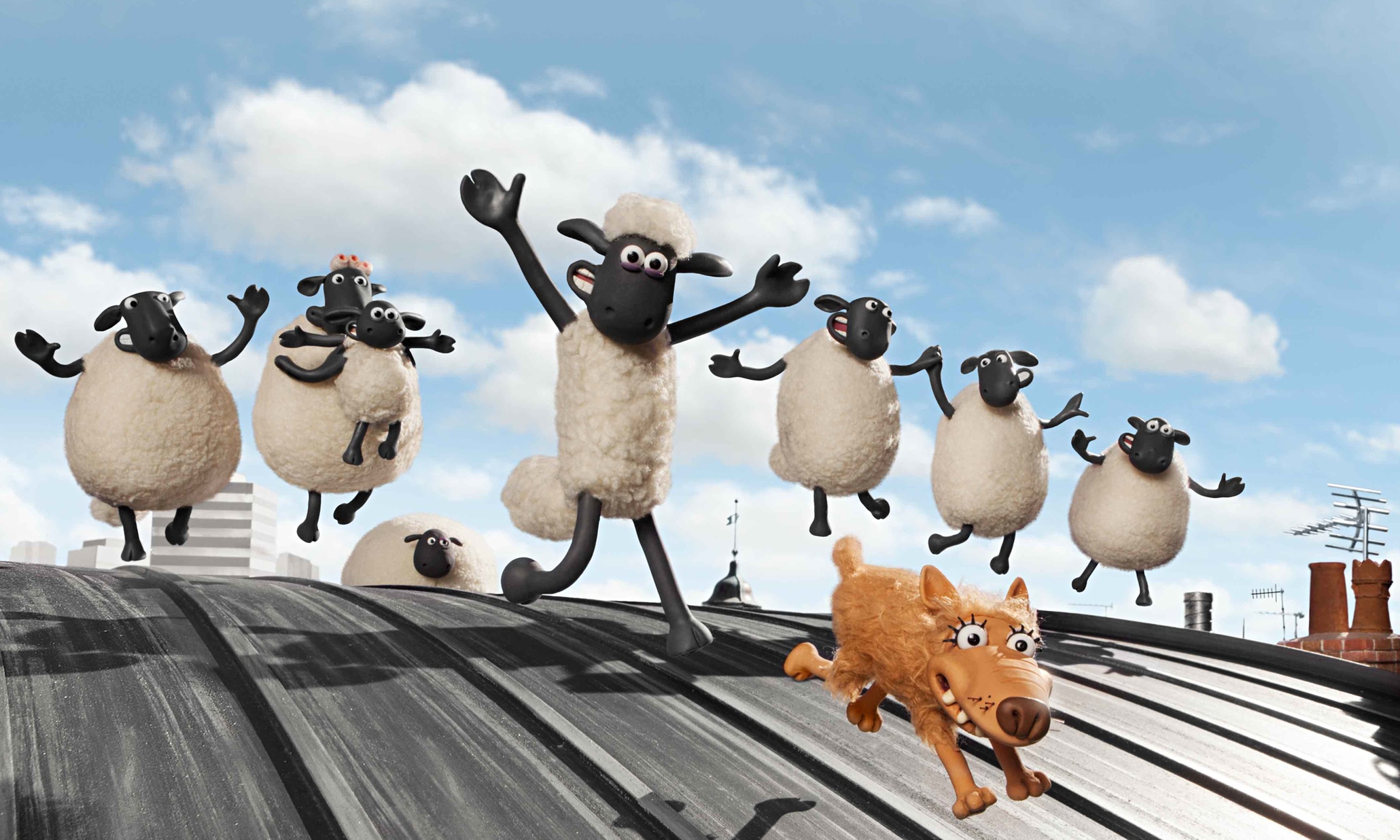
In a word?  Charming.

The film also invites descriptive words like understatementsubtletycleverness, and a word that Pixar coined, simplexity: simple in form but complex and richly-detailed in execution.  In this age of giant tentpole, effects-driven family films, Aardman is still doing their own thing the same way they've been doing it for 20+ years.

Shaun the Sheep has starred in a series of his own countryside-set mini-shorts, but made his debut in the Wallace and Gromit classic A Close Shave.  Like Gromit, he can express such a deftly-balanced multitude of qualities - confidence, irritation, cautiousness - with just two round eyeballs, no dialogue.  Gromit never got to carry his own story, however.  Here, Shaun carries an entire wordless feature, and the results are delightful.

Shaun and his sheep cohorts have grown bored of routine on the pasture, so one day they lull the Farmer (lovably clumsy) to sleep in his trailer and hold a house party behind his back.  Several hijinks later, the trailer rolls into the city and the Farmer emerges with a concussion and amnesia.  It is up to the flock and Bitzer the sheepdog to rescue their owner and rekindle their affection for him in the process.

The jokes are choice: writer/director duo Richard Starzak and Mark Burton are very attentive to factoring early gags into the plot later on (my favorite sight gag involves a pig restoring two vandalized pictures of the Farmer: it's keeps going without overstaying its welcome).  It also wouldn't be an Aardman film without an ingenious, hand-crafted contraption: here it's a comical makeshift police-horse operated similarly to the bird-airplane in Chicken Run.

Some issues: the movie could have dispensed with the occasional rap/pop song and fart joke (does Aardman really need to do that anymore, now that Dreamworks is out of the picture?), and the villain - an exterminator hell-bent on capturing the flock -  could have dropped out at the halfway point, instead of showing up for a protracted action climax.  Aardman's features often include a big finish, and it's plain unnecessary: they get by so well on the strength of their small-scale charm!

These are fortunately minor issues that hardly get in the way of everything so exquisitely right here.  Let's hope that the artists at Aardman, and their unique way with plasticine, continues to grace American cinemas.


The Science Behind Pixar

As a kid curious about how animation (including the then-blossoming world of CG animation) worked, there wasn't much out there in the way of books, videos, or interactive educational tools that I could access and wrap my head around.

I officially envy today's generation of little aspiring animators. Over the past few years, Pixar and the Boston Museum Of Science collaborated on an exhibit showcasing Pixar's technical processes, and the result is 'The Science Behind Pixar'. I visited the exhibit at the end of July, and oh my God.


Where to begin?!? Literally! When the doors opened, my mouth fell open at how expansive it is. There are individual sections of the exhibit devoted just to modeling, rigging, animating, surfacing, camerawork, lighting, rendering, the list goes on!

The first thing to note is that Pixar's purely artistic side is omni-present in the exhibit. Production may be technical, but technical decisions are rooted in artistic decisions made in pre-production. Gorgeous, blown up pieces of concept art are everywhere, storyboards are showcased, and there are even original sculpts you can get up close and personal with!


The greatest accomplishment of this exhibit is its interactivity. Kids have a chance to learn how CG animation works by actually trying it themselves with simplified versions of real programs. In CG modeling, there are three major X-Y-Z transformations: scaling, rotation, and position, and families can experiment with all three using simplified but recognizably Maya-like programs. At Pixar, crowds and extras, like the background robots in WALL-E, are built by changing one relatively small set of robot parts into infinite combinations of mechanical appendages, and kids can take build numerous toy robots with just a few of these parts. And actual animation of a character is usually finessed in a graph editor, and kids can grasp the concept of easing in-and-out by getting Mike Wazowski to wave his hand in different timing setups!


I learned a few things myself! For instance, while I new that the emotions in Inside Out are made up of thousands of energy particles, I did not know that those were actually added during the surfacing stage, and that animators treated their skin like solid surfaces! And with regards to rendering, I never stopped to realize that when a clump of pixels in one section of one frame has almost the same hue, it renders faster than a subject in the frame with lots of different colors. That's why background vehicles in Cars are actually very simplified models, because they render faster and no one will notice they are not geometrically complex because they occupy such a small percentage of the pixels in a frame.

My favorite section of the exhibit by far illustrates the entire technical process from beginning to end: in a circular, 360-degree room, you see individual screens showcasing the progression of a scene from Inside Out: Story - Layout - Animation - Simulation - Lighting - Rendering. It's a glorious testament to the process of CG-animated filmmaking as a whole, and they were smart to use their most recent feature as an example, as that would be the one that's freshest in audiences' minds.


I went with a few friends who are studying filmmaking, and one of them was followed around the whole exhibit by a young girl who kept asking her questions about everything she saw. At the end, the girl asked my friend if she did this for a living.  My friend said yes, and the girl said that she really wants to do it as well. That one exchange validates the purpose and potential of this exhibit: to inspire a new generation of artists, technicians, and visual storytellers.